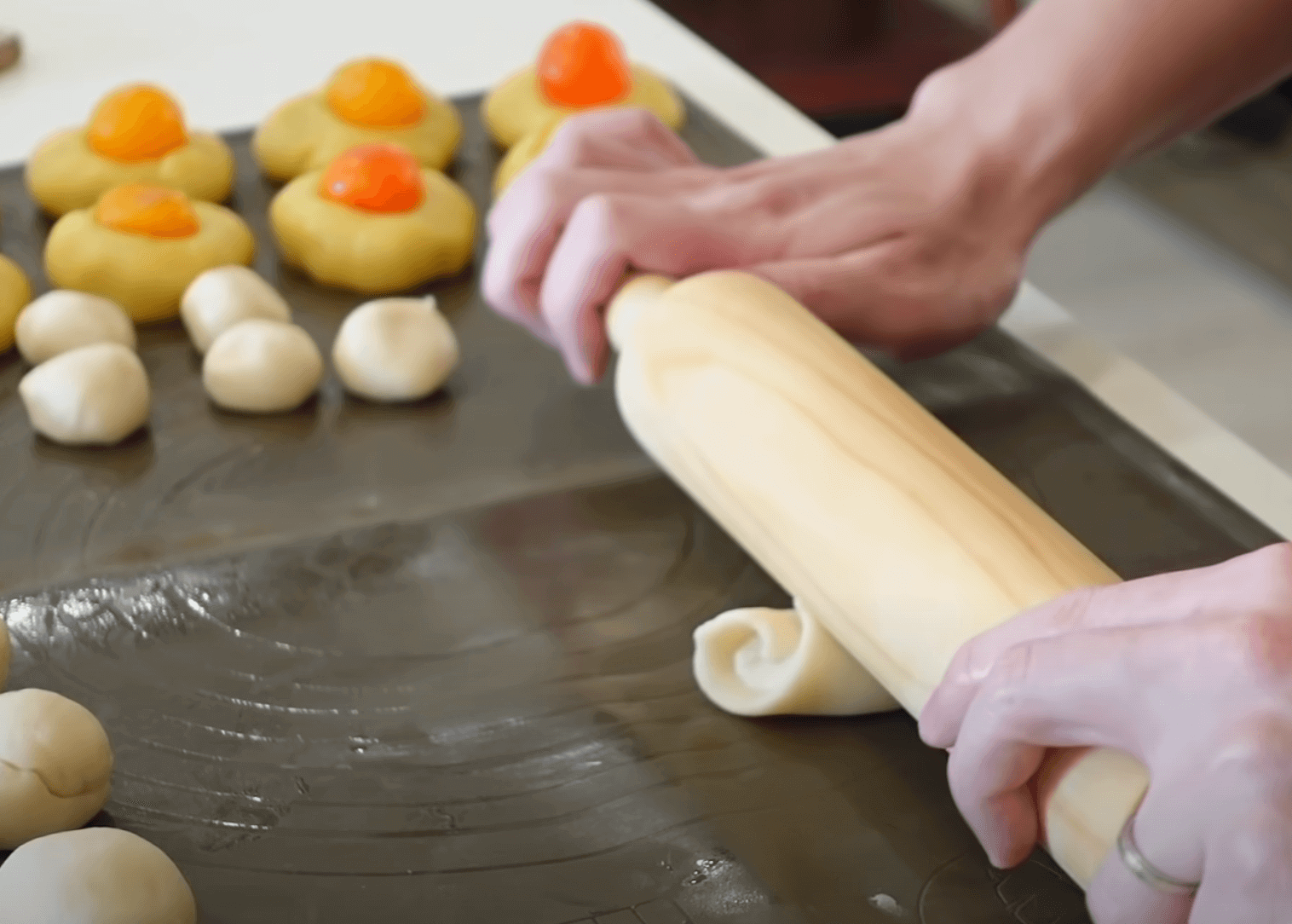
No need to go far, how to make Pia cake the simple way that Bao Minh introduces below will help you create these bánh Pía delicious specialties with the authentic traditional taste by yourself. Let's start exploring how to make Pia cake in the article below!
See more: Banh Pia specialty - a perfect combination of flavors
Ingredients (To make 10 Pia cakes):
Tools needed: Oven, non-stick pan, blender, rolling pin...
Step 1: Stir-fry the mung bean and durian mixture
First, wash the mung beans and soak them in water for 4 – 6 hours.
Next, add 100g of soaked peeled mung beans along with 300ml of water and 1/2 teaspoon of salt into a pot and cook over medium-low heat until the beans are soft. Remember to skim off the white foam that rises to the top while cooking!
When the water in the pot has evaporated and you can mash the mung beans until soft, take them out, put them in a blender, and blend until smooth.
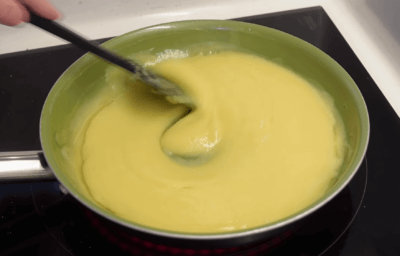
Put the blended mung beans along with 60g of sugar into a non-stick pan, turn on low heat, and stir constantly. Wait until the sugar has completely dissolved, then add 30ml of cooking oil little by little and mix well so the mixture is well combined.
Next, mix 10g of cornstarch with 20ml of filtered water until dissolved, then slowly add it to the bean pan. Use a spoon to mix until the mixture is combined.
Continue stirring over low heat until the mixture becomes a sticky, soft, and smooth block, then turn off the heat. Put the mixture into a large bowl, cover it tightly with plastic wrap, and set it aside.
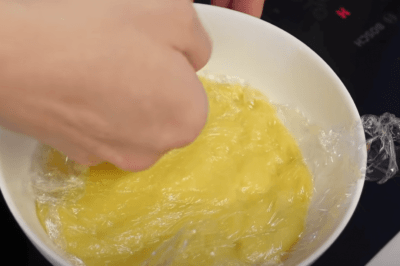
Continue to add 200g of durian meat and 20g of sugar to the pan, and turn on low heat. Stir constantly until the sugar has melted and the durian turns slightly translucent, and you are done.
Step 2: Making the dough for the crust
Put 230g of all-purpose flour, 45g of sugar, and 1/3 teaspoon of salt into a bowl and mix well with a spatula. Then, add 60ml of cooking oil to the dry flour mixture and mix well.
Next, slowly add 75ml of filtered water and mix until the mixture becomes a uniform dough block, then take the dough out and knead it evenly until the dough block is soft and smooth.
Place the dough block in a bowl and cover tightly with plastic wrap. Let the dough rest for about 15 – 20 minutes.
Step 3: Mixing the oil dough
Put 110g of all-purpose flour and 45g of cooking oil into a bowl. Use a spatula to mix until the dough block becomes uniform, soft, and smooth, then cover it tightly with plastic wrap. Let the dough rest for about 15 – 20 minutes as well.
Step 4: Preparing the filling
Divide the prepared mung bean filling into 10 equal parts, each weighing about 38g.
Place a mung bean filling ball in your hand and flatten it. Place 1 teaspoon of durian in the middle, then seal it and roll it into a ball.
Next, place the prepared salted egg yolk on top of the filling balls, place them on a plate, and cover tightly with plastic wrap.
Step 5: Dividing and rolling the dough
Divide the crust dough and oil dough into 10 parts, corresponding to the prepared filling.
Take a piece of crust dough, place it on a flat surface, and flatten it. Place a piece of oil dough in the center and spread it evenly. Note: do not spread it to the edge of the crust dough. Then seal it to form a ball.
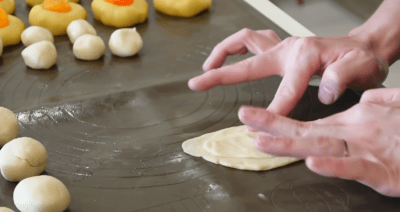
Turn the dough ball over, keep the sealed edge at the bottom, and use a rolling pin to roll it into a thin, long oval piece. Then, flip the other side of the dough, roll the dough up, and roll it thin lengthwise again.
Finally, use plastic wrap to cover the dough tightly so it does not dry out.
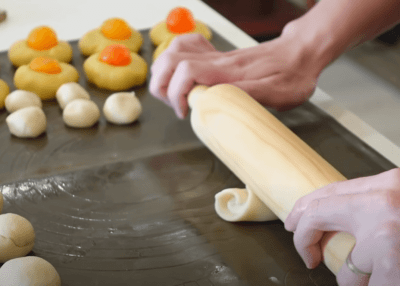
Step 6: Wrapping the filling
Place the filling in the middle of the dough piece, seal the edges, and shape it so the crust completely covers the filling inside.
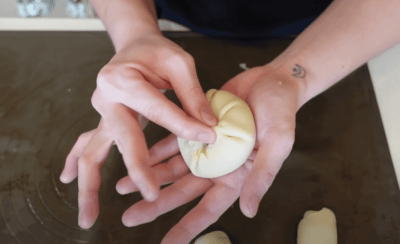
Step 7: Baking the cake
Turn on the oven to 180°C and preheat it for 15 minutes before putting the Pia cakes in to bake.
Line a baking tray with parchment paper and arrange the cakes evenly on the tray. Place it in the middle of the oven and bake at 175°C for 15 – 18 minutes.
After that, strain 1 egg yolk into a bowl along with 5ml of water. Whisk until the yolk is dissolved.
Now take the cakes out and brush a thin layer of egg yolk over the surface of the cakes, then put them back into the oven. Continue baking for 5 – 7 minutes at 175°C.
See more: The simplest and most delicious durian and mung bean Pia cake recipe
Finished product
So, with the way to make Pia cake that Bao Minh introduced above, you can complete the delicious salted egg, mung bean, and durian Pia cake.
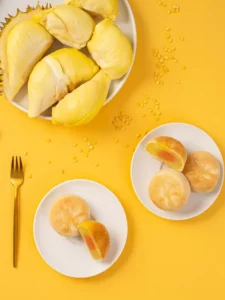
You should wait a day for the Pia cake to have the best flavor because by then the oil has released, making the cake softer and more flavorful.